Does Sleepmaxxing Work? What the Evidence Says (2026)
Sleepmaxxing is the viral trend of optimizing sleep with supplements, devices, and routines — but the most-hyped tools have the weakest evidence. The strongest support is for unglamorous basics: a consistent schedule, morning light, exercise, and CBT-I. Magnesium helps modestly; sleep trackers, mouth taping, and grounding sheets are far less proven, and over-optimizing can backfire.
Medical disclaimer: This article is for general information only and is not medical advice. If you have persistent sleep problems, loud snoring, choking or gasping during sleep, suspected sleep apnea, or questions about supplements, melatonin, or mouth taping, talk to a healthcare professional.
Sleepmaxxing is the viral trend of trying to optimize sleep with supplements, devices, and carefully engineered routines. The idea is appealing: if better sleep is good, then more optimization should be even better. But when you look at the evidence, a different picture emerges. The strongest support is still for the unglamorous basics — a consistent schedule, morning light, regular exercise, and CBT-I.
Supplements like magnesium may offer modest benefits, while many of the trend's most popular tools, including sleep trackers and mouth taping, are far less proven. In some cases, trying too hard to optimize sleep can even work against you.
At first glance, sleepmaxxing sounds like a modern wellness success story. Millions of people are paying more attention to their sleep these days, tracking it, talking about it, and looking for ways to improve it. That's a positive shift. Sleep is one of the most important pillars of health, and for years it received far less attention than diet or exercise.
There's a curious pattern that shows up again and again when you look at the sleepmaxxing trend. The tactics attracting the most attention — and often the most money — aren't necessarily the ones backed by the strongest evidence.
Magnesium glycinate generates enormous search volume. Sleep trackers are everywhere. Mouth taping has become a social-media ritual. Grounding sheets promise better sleep through direct contact with the earth.
None of that automatically makes them ineffective. But when researchers evaluate the evidence behind these popular sleepmaxxing tools, the results are often far less impressive than the hype.
Meanwhile, the interventions with the strongest evidence are remarkably ordinary: going to bed and waking up at consistent times, getting light exposure early in the day, exercising regularly, and building a calming wind-down routine. They're free, they're not particularly exciting, and almost nobody is filming them for TikTok.
That doesn't mean sleepmaxxing is all hype. Far from it. The trend has encouraged many people to take sleep more seriously for the first time. The challenge is separating the parts that genuinely improve sleep from the parts that mainly generate clicks, views, and product sales.
What sleepmaxxing actually is
Sleepmaxxing is not a medical protocol. It is a social-media label for sleep optimization: stacking habits, supplements, trackers, gadgets, and environmental tweaks to improve sleep quality, fall asleep faster, get more deep sleep, or wake up feeling better.
That matters because “sleepmaxxing” itself has not been studied as a defined treatment package. Harvard Health has noted that searching PubMed for the term returns no medical studies on sleepmaxxing as a specific intervention. What we do have is evidence on the individual pieces: sleep hygiene, circadian rhythm alignment, exercise, CBT-I, magnesium for sleep, melatonin, trackers, devices, and mouth taping.
A useful framing comes from Duke sleep specialist Dr. Aatif Husain, who described sleepmaxxing as sleep hygiene “on steroids.” That’s fair. At its best, the trend repackages good habits. At its worst, it makes sleep feel like one more performance metric.
BetterSleep doesn’t sell supplements, trackers, mouth tape, grounding sheets, or blackout gadgets. That makes the evidence question simpler: what actually helps, and what can you ignore?
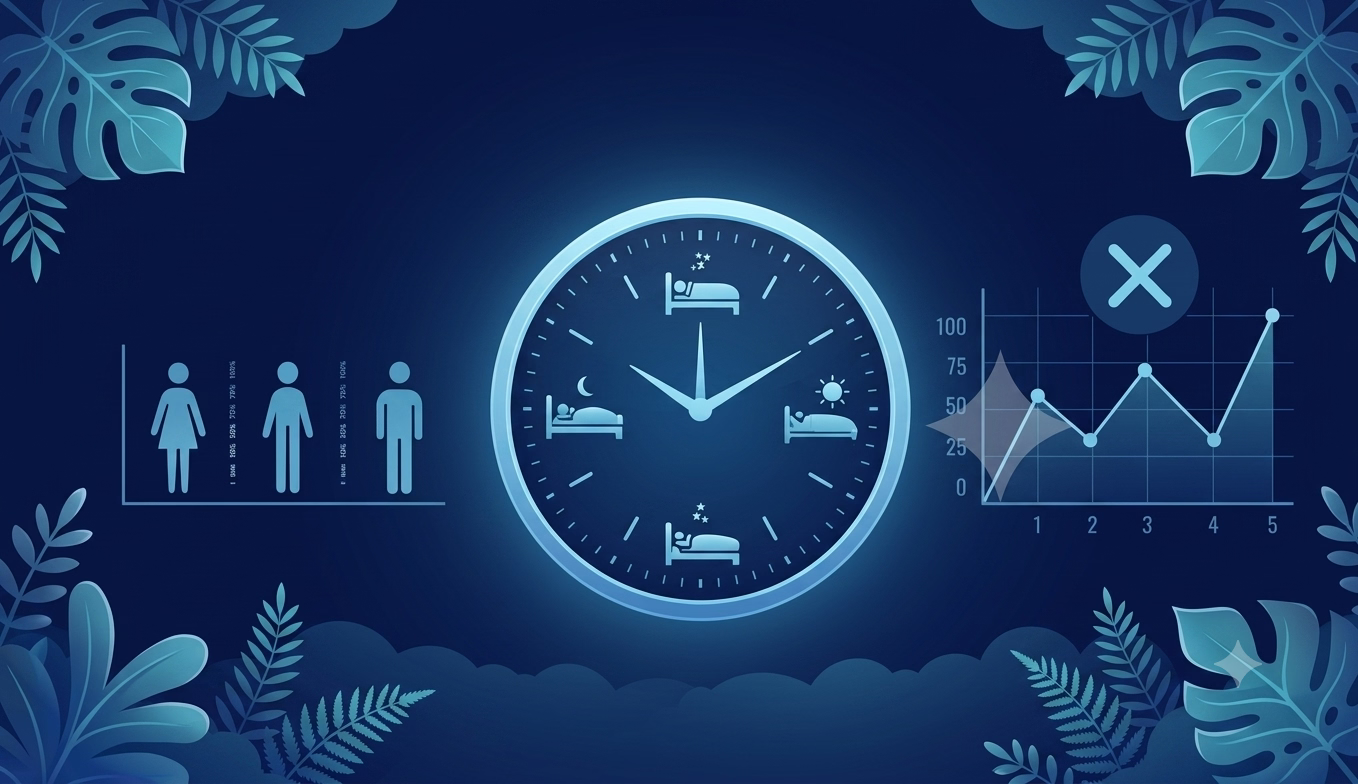
The evidence gap, in one chart
The strongest sleepmaxxing tactics are not necessarily the most searched. This table is the core verdict.
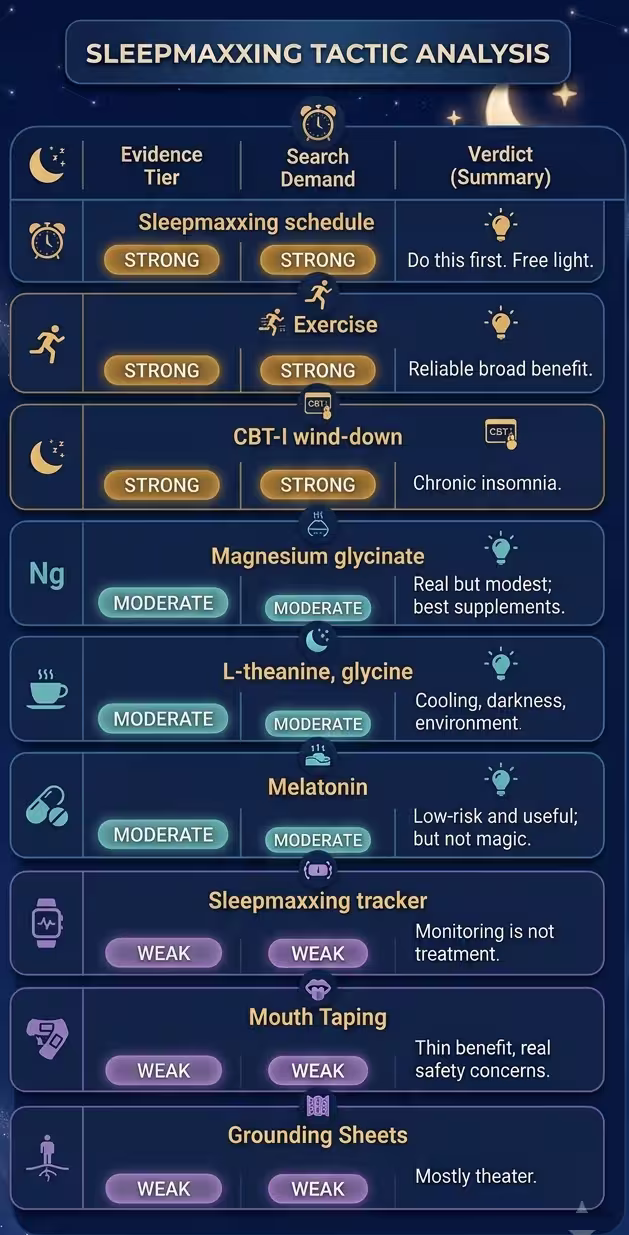
The pattern is the article in miniature: the boring stuff wins.
STRONG evidence: the foundations
Consistent schedule, light, and sleep hygiene
The best-supported sleepmaxxing routine starts before you buy anything. A consistent wake time, steady sleep window, morning light, dimmer evenings, and fewer late-night disruptors all support the circadian rhythm that tells your body when to feel alert and when to wind down.
This is where ordinary sleep hygiene still earns its place. It isn’t glamorous, and it won’t make a great TikTok, but the evidence base is far stronger than it is for most viral sleep hacks. A 2023 review of sleep physiology and sleep hygiene highlights familiar but durable targets: adequate sleep duration, consistent timing, physical activity, and avoiding late caffeine, alcohol, heavy meals, and bright light.
For practical next steps, BetterSleep’s guide to how to get more deep sleep pairs well with this foundation: build the evening around regularity, darkness, and a predictable wind-down, not a pile of new products.
Exercise, especially earlier in the day
Exercise is another strong-tier intervention because it affects sleep through several pathways: circadian timing, stress regulation, body temperature, mood, and sleep pressure. The best evidence does not require a heroic routine. Regular movement matters more than chasing the perfect workout.
Timing still counts. Very intense exercise close to bedtime may feel activating for some people, while morning or afternoon movement tends to fit better with circadian rhythm and nighttime sleep pressure.
CBT-I and structured wind-down
CBT-I, or cognitive behavioral therapy for insomnia, is not a relaxation hack. It is a structured treatment for chronic insomnia that targets the behaviors and thought patterns that keep sleep problems going. It often includes stimulus control, sleep restriction, cognitive work, and sleep hygiene education.
That's why CBT-I sits in the Strong evidence tier in the table above. If insomnia is persistent, CBT-I has a much stronger evidence base than any supplement, sleep gadget, or tracking device.
For everyone else, the takeaway is simpler: build a consistent wind-down routine. Going through the same sequence each night — dimming the lights, putting screens aside, listening to calming audio, practicing meditation, or reading a sleep story — helps create a reliable transition between the day and sleep. BetterSleep's guide to the science of sleep meditation explains why these rituals can be surprisingly effective.
MODERATE evidence: real but oversold
Magnesium glycinate and magnesium for sleep
Magnesium is probably the clearest example of the Moderate evidence tier. It isn’t full-out nonsense, but it also isn’t the sleep solution the internet often makes it out to be.
A 2025 systematic review and meta-analysis found that dietary supplement interventions can modestly improve sleep outcomes, including sleep latency, sleep efficiency, total sleep time, and wake after sleep onset. But effects varied by compound and population. That’s the key point: supplements may help some people, but they don’t outrank the foundations.
Magnesium glycinate gets attention because it’s a well-absorbed form many people tolerate. Still, “magnesium for sleep” belongs below schedule, light, exercise, and CBT-I. If you try it, introduce one supplement at a time, watch for side effects, and check with a healthcare professional if you take medications, have kidney disease, are pregnant, or have a medical condition.
It's also worth asking whether your overall diet supports healthy sleep before turning to a growing collection of supplements. BetterSleep's best foods for sleep article offers a more sustainable long-term approach than relying on capsules, powders, or gummies to do the heavy lifting.
L-theanine, glycine, and melatonin
L-theanine, glycine, tart cherry, tryptophan, and similar sleep supplements have some plausible mechanisms and trial support behind them. One double-blind study of a multi-ingredient nutritional stack found shorter sleep onset latency and modest gains in total sleep time and sleep efficiency. Polyphenol-rich interventions have also been linked with shorter sleep latency and more total sleep time, though not consistent improvements across every outcome.
That's encouraging, but not a reason to combine five supplements at once. When you combine supplements, you make it harder to know what helped, what did nothing, and what caused side effects.
Melatonin deserves extra caution. It can be useful for short-term circadian issues, such as jet lag or delayed sleep timing, but it is not a general poor-sleep solution. Avoid treating it like a nightly sedative. Use the lowest appropriate dose only with clinician guidance, especially for children, people who are pregnant, individuals with chronic health conditions, and anyone taking prescription medications.
Cooling, darkness, and environment
Bedroom environment lands in the Moderate evidence tier because there is good reason to think it helps, but the evidence isn’t as strong as it is for fundamentals like a consistent sleep schedule, morning light, exercise, and CBT-I. Darkness reduces light disruption. A cooler room can support the body's normal nighttime temperature drop. Sound masking can make an inconsistent environment feel calmer.
This is where simple tools can help without becoming another obsession. A fan, blackout curtains, white noise, or the BetterSleep sound mixer can support a better sleep routine. The point is not to engineer a perfect sleep cave. It is to remove obvious friction.
WEAK evidence / theater: be cautious
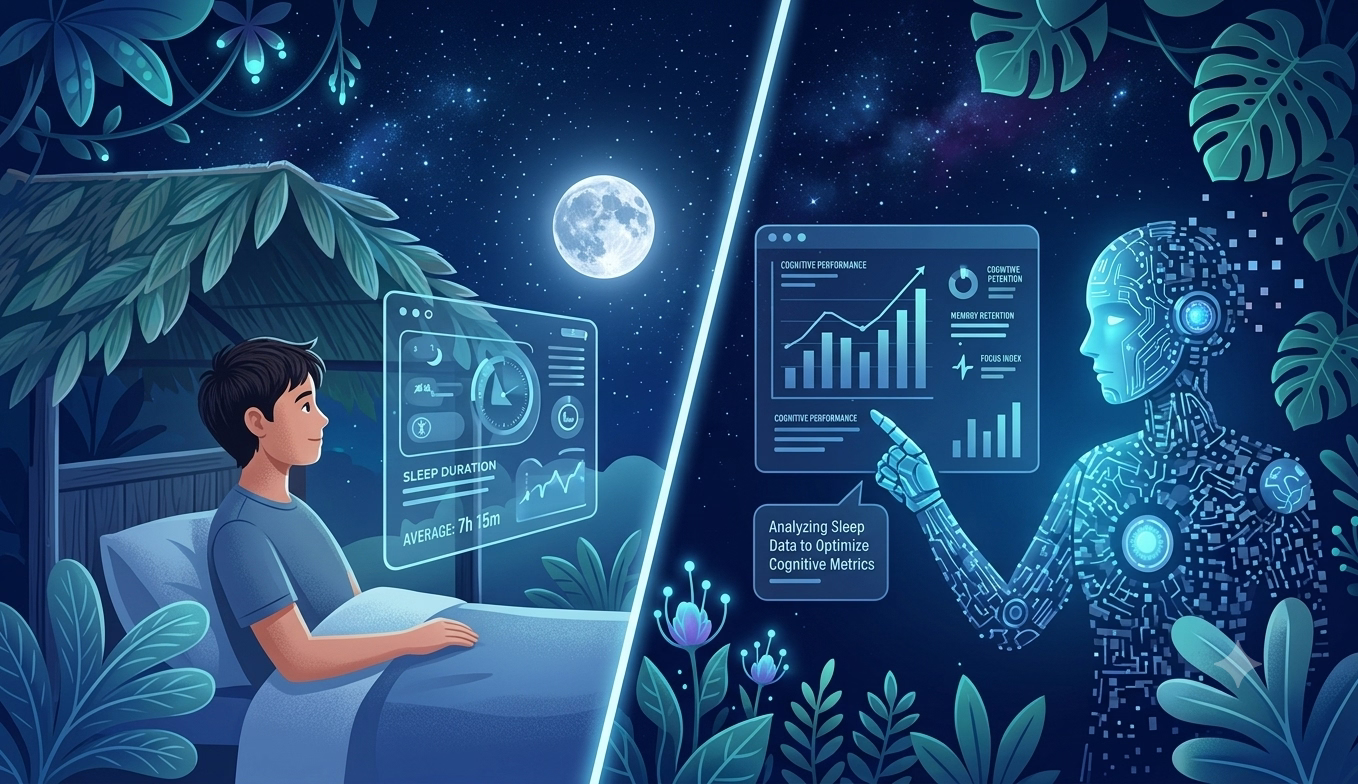
Sleep trackers
A sleep tracker can be useful if it helps you spot patterns: irregular bedtimes, short sleep windows, late-day caffeine intake, or nights when alcohol disrupts rest. But tracking is not the same as treating.
Consumer trackers are better understood as monitoring tools than sleep interventions. Device research is still emerging, and many studies show narrow benefits, device-specific effects, or limitations around placebo control and standardization. A wearable that helps one person fall asleep faster isn’t proof that tracking your sleep score will improve your sleep.
This is why tracking belongs in the Weak evidence tier as a sleepmaxxing fix. Use it as a loose weekly guide, not a nightly report card. BetterSleep’s Sleep Cycle vs BetterSleep comparison article makes the distinction clearly: tracking-first apps analyze your nights, while wind-down tools help you get through them.
Mouth taping
One of the more controversial sleepmaxxing trends is mouth taping — placing a piece of tape over the lips at night in an attempt to encourage nasal breathing.
It also requires the strongest safety language in this article. A 2025 PLOS ONE systematic review found thin evidence for benefit and flagged real potential harm when people tape their mouths indiscriminately, especially if they have nasal obstruction, mouth-breathing issues, or undiagnosed sleep apnea.
Do not try mouth taping if you have nasal congestion, a deviated septum, trouble breathing through your nose, heavy snoring, choking or gasping at night, or possible sleep apnea. Taping your mouth shut can create an asphyxiation risk in the wrong person. If snoring or mouth breathing is the issue, talk to a clinician. Safer, better-studied options exist.
Grounding sheets and gadgetry
Grounding sheets, earthing mats, and many sleep gadgets belong at the bottom of the evidence stack. They may feel relaxing because rituals can be calming. That doesn’t make them strong sleep interventions.
The same principle applies to many sleep-related wellness claims. If something helps you relax, that's fine. Just don't confuse a pleasant ritual with a proven treatment for insomnia.
The weak-tier rule is simple: if it costs money, makes big claims, and has little high-quality sleep evidence behind it, skip it altogether or at best treat it as optional.
The orthosomnia trap
Orthosomnia is what happens when sleep optimization starts making sleep worse. The term describes anxiety or preoccupation caused by trying to achieve perfect sleep, often through wearable data.
This is one of the main risks of sleepmaxxing.
A 2024 general-population study found that a substantial share of tracker users showed markers associated with orthosomnia. The pattern is easy to recognize: you wake up feeling okay, check your sleep tracker, see a bad score, and suddenly decide you slept terribly. Or you go to bed already worried about protecting tomorrow’s number.
Ironically, that's the opposite of what good sleep requires. Sleep responds poorly to pressure. The harder you try to force a perfect night, the more alert your brain can become.
A tracker is fine if it reduces guesswork. It's a problem if it turns sleep into a nightly exam. A lower-than-expected sleep score doesn't necessarily mean you slept badly, just as a high score doesn't guarantee you'll feel great the next day. Your daytime energy, mood, and functioning still matter more than a number on a screen.
How to sleepmaxx without losing the plot
The best version of sleepmaxxing is boring, cheap, and calm.
Start here:
- Pick a consistent wake time and protect it most days.
- Get outdoor light early in the day.
- Move your body, preferably before evening.
- Keep caffeine, alcohol, heavy meals, and bright light away from bedtime.
- Build a repeatable wind-down routine: dim lights, calming audio, a sleep story, breathing, or meditation.
- If insomnia persists, look into CBT-I or speak with a clinician.
That’s also where BetterSleep fits best: not as another metric to chase, but as a wind-down tool. Sleep stories, meditations, breathing exercises, and even calming audio such as 174 Hz solfeggio frequency tracks can help make bedtime feel familiar and less effortful.
If you want one do-it-tonight change, choose a bedtime cue you can repeat: same time, same sound, same low-light routine. Then stop optimizing.
The bottom line
The least flashy sleepmaxxing tactics have the strongest evidence. The most-hyped ones usually have less.
Prioritize schedule, light, movement, wind-down, and CBT-I when needed. Treat supplements as optional. Treat trackers as rough guides. Be careful with mouth taping. Skip the theater.
BetterSleep can help you build the calm part of the routine — the part that makes sleep easier without turning it into another score.
FAQ
Does sleepmaxxing actually work?
Parts of it do, but not necessarily the parts that get the most attention. The strongest evidence supports consistent sleep timing, morning light, regular exercise, CBT-I, and a calming wind-down. Supplements like magnesium glycinate may help some people modestly. Sleep trackers, mouth taping, grounding sheets, and gadgets are much less proven. Sleepmaxxing is a social-media label, not a tested medical protocol.
Is magnesium good for sleep?
Magnesium is one of the better-supported popular sleep supplements, and magnesium glycinate is a well-absorbed form many people tolerate. But the evidence still places magnesium in the Moderate tier rather than the Strong one. It may help some people, especially if their magnesium intake is low, but its effects are generally smaller than those seen with the sleep fundamentals discussed earlier. A supplement can complement a healthy sleep routine; it can't replace a consistent schedule, morning light exposure, regular exercise, and a reliable wind-down. Introduce one supplement at a time, and check with a healthcare professional if you take prescription medications or have an underlying health condition.
Is mouth taping safe?
Mouth taping can be risky, especially for people with nasal obstruction, congestion, heavy snoring, or possible sleep apnea. A 2025 systematic review found limited evidence of benefit and warned about possible harm, including asphyxiation risk in vulnerable people. Don’t tape your mouth shut if breathing through your nose isn’t easy and reliable. If snoring or mouth breathing is a concern, talk to a clinician.
Can tracking my sleep make it worse?
Yes. For some people, sleep tracking creates orthosomnia: anxiety or preoccupation with sleep scores that makes sleep harder. Trackers can be useful for broad patterns, but nightly scores are not perfect measures of recovery. If your tracker makes you anxious, take a break or check trends weekly instead of daily. How you feel during the day matters more than one bad number.